Total Pest Control Ltd
For a Free Consultation, Call 604-349-6402

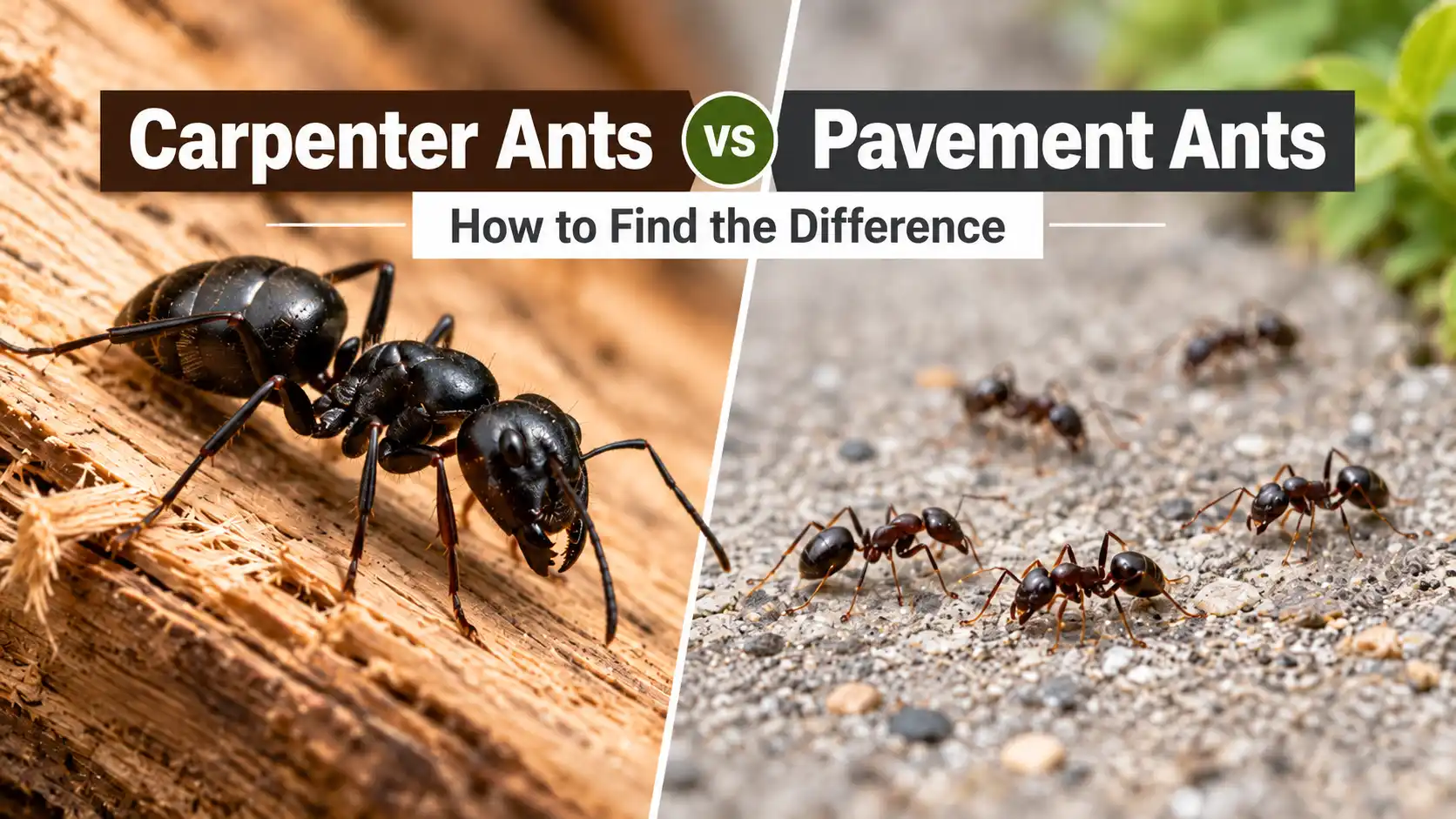
A large ant near a window and a trail of small ants crossing the kitchen floor may look like the same problem at first, but they can point to very different ant species. Carpenter ants and pavement ants differ in size, nesting behavior, activity patterns and the evidence they leave behind.
The easiest way to distinguish carpenter ants vs pavement ants is to consider several clues together. Size is a useful starting point, but where the activity originates, how the ants move and whether you find wood debris or excavated soil can provide a much clearer indication.
Correct identification matters because carpenter ants can excavate wood to create nesting galleries, while pavement ants generally establish colonies in soil beneath concrete, stones and other hard surfaces. If you’re already seeing signs of either type and want the problem resolved rather than just identified, our ant control services in Surrey, BC handle both species.
| What to Check | Carpenter Ants | Pavement Ants |
|---|---|---|
| Relative size | Noticeably larger | Much smaller |
| Typical color | Usually dark; some have reddish areas | Brown to black |
| Common association | Wood and moisture-prone areas | Soil, concrete, patios and foundations |
| Activity pattern | May appear individually or travel between nesting and foraging areas | Often form noticeable foraging trails |
| Material nearby | Sawdust-like frass may be present | Fine soil or sand may appear around cracks |
| Wood damage | Can excavate wood for nesting | Do not excavate structural wood |
| Main concern | Possible nesting activity involving wood | Persistent nuisance activity |
No single characteristic confirms the species. A more reliable identification comes from several clues pointing in the same direction.
Size is usually the easiest difference to notice without magnification.
Carpenter ants are among the larger ants commonly encountered around homes, while pavement-ant workers are considerably smaller. Carpenter-ant workers can also vary in size within the same colony, so not every individual will look identical.
Very small ants moving together in a defined trail are more consistent with pavement ants. Significantly larger ants make carpenter ants a stronger possibility.
Where ants appear to come from can be more useful than where you happen to see one.
Small ants repeatedly emerging from cracks beside patios, driveways, concrete slabs or foundations are more consistent with pavement-ant behavior. These ants commonly establish nests in soil beneath protected hard surfaces before workers move away from the colony to forage.
Large ants repeatedly appearing around timber, concealed structural openings or moisture-prone areas make carpenter ants more likely.
In British Columbia, moisture is particularly relevant when carpenter ants are suspected. The Province of BC advises checking damp and decaying wood when investigating carpenter-ant activity, making areas affected by moisture intrusion or deteriorating timber worth closer attention.
Around Lower Mainland properties, this can include exterior wood, decks, window areas, crawl spaces and other parts of a building where timber remains damp.
However, an ant seen beside a window does not automatically mean the colony is inside the window frame. Follow the pattern of activity rather than drawing a conclusion from one sighting.
Pavement ants often establish visible foraging trails between their colony and a food source. Numerous small ants may follow the same route along a floor edge, foundation or outdoor surface.
Carpenter-ant activity can look different. Individual workers may travel between outdoor nesting areas and buildings while searching for food.
Health Canada recommends observing carpenter-ant movement patterns when trying to locate where activity originates. Carpenter ants are also particularly active after sunset, so evening observations can provide useful additional evidence.
The material surrounding ant activity can provide another important clue.
Carpenter ants excavate wood to create nesting galleries and remove unwanted material from the nest. This can produce piles of sawdust-like debris known as frass.
Pavement ants excavate soil instead. Fine particles of soil or sand may therefore appear around cracks in pavement, concrete or foundation edges close to a nest entrance.
A useful comparison is: Wood-like debris combined with repeated large-ant activity may point towards carpenter ants. Fine soil around hard-surface cracks combined with small trailing ants may point towards pavement ants.
Neither clue should be considered on its own.
Seeing an ant can narrow down the possibilities, but it does not always reveal where the colony is located or whether a building contains an established infestation.
| What You Notice | What It Could Suggest | What It Does Not Automatically Prove |
|---|---|---|
| One large ant indoors | A carpenter ant may be foraging | There is a nest inside the wall |
| Several small ants on a counter | Small ants are foraging for food | The colony itself is in the kitchen |
| Sawdust-like debris near wood | Wood excavation may be occurring | Every pile of sawdust is caused by ants |
| Small ants beside a driveway crack | A soil nest may be nearby | Every ant near pavement is a pavement ant |
| Large ants outdoors | Carpenter ants may be present nearby | The building has structural damage |
The Province of British Columbia notes that the presence of carpenter ants around a property does not necessarily mean there is an infestation. Frequency, location and accompanying evidence provide much more useful information than one isolated ant.
No. The place where an ant is seen is not necessarily where its colony is located.
Ant workers leave their nests to forage, so indoor activity can originate outside the building.
Carpenter ants may have a parent colony outdoors while workers travel around or into a building looking for food. Established colonies can also develop satellite colonies in suitable nearby locations.
This means repeated indoor activity could represent ants entering from outdoors or activity connected with a nest closer to, or within, the structure.
Watching where the ants travel and whether they repeatedly emerge from the same location can help distinguish between these situations.
Pavement ants commonly nest in soil beneath sidewalks, driveways, patios, slabs and other protected surfaces. Workers can move from those nests and enter buildings through small gaps while foraging.
A trail across a kitchen floor therefore does not automatically mean the colony is underneath the kitchen.
The material around suspected nesting activity can make the comparison easier.
Carpenter ants do not eat wood. Instead, they excavate it to create nesting galleries and remove material from those spaces.
The resulting debris can resemble coarse sawdust or wood shavings and may accumulate near openings associated with ant activity.
Frass is more meaningful when it appears alongside repeated large-ant activity. Woodworking, deteriorating timber and other insects can also produce wood debris.
Pavement ants excavate soil rather than wood.
Fine particles of soil or sand may appear around cracks in pavement, concrete or other hard surfaces close to a nest entrance. When small ants repeatedly emerge from the same crack alongside disturbed soil, pavement ants become a stronger possibility.
Carpenter ants generally create the greater property concern because they can excavate wood when establishing nesting galleries.
They do not eat wood like termites, but continued excavation can affect wooden material where colonies become established. Their activity is also commonly associated with damp or deteriorating timber, so signs of moisture are worth investigating alongside the ant activity itself.
Pavement ants are primarily nuisance pests. They can establish persistent colonies around buildings and repeatedly forage indoors, particularly where food and water are available, but they do not excavate structural wood in the way carpenter ants do.
The difference is therefore more than simply large ants versus small ants. It is also the difference between a potential wood-nesting concern and a persistent soil-nesting nuisance.
An occasional carpenter ant indoors is different from repeated activity concentrated around the same part of a building.
The Province of British Columbia advises investigating whether an indoor nest may be present if more than 10 to 12 carpenter ants are seen inside during an evening.
This should not be treated as a universal infestation threshold. Instead, it highlights why frequency and patterns of activity matter.
Other reasons to investigate further include:
When our technicians assess recurring ant activity, identification is not based on color alone. Size, movement patterns, the point where activity originates, moisture conditions and material around suspected nesting areas all provide useful evidence for distinguishing carpenter ants from pavement ants and other ant species.
If the activity keeps returning, the species cannot be confidently identified or ants appear to be emerging from a concealed part of the building, professional assessment can help determine where the problem originates. Request an inspection for our ant control service across BC for established ant problems in homes and businesses.
Before drawing conclusions, record what is actually happening.
Pay attention to:
A close-up photograph can also help with identification. If possible, include an object for scale and photograph the location where the ants appear to be emerging, not just the ant itself.
Yes. Carpenter ants are generally much larger than pavement-ant workers, making size one of the quickest ways to distinguish between them. Because carpenter-ant workers can vary in size, location, behavior and other evidence should also be considered.
No. Pavement ants primarily nest in soil and do not excavate structural wood. Their main concern around homes is persistent foraging and nuisance activity.
No. Carpenter ants excavate wood to create nesting galleries but do not consume it as food. Material removed from the galleries may appear as sawdust-like frass near nesting activity.
Not necessarily. Individual workers can enter from an outdoor colony while foraging. Repeated indoor activity, frass or ants consistently emerging from the same structural location provide stronger reasons to investigate.
Yes. Carpenter-ant workers can forage away from outdoor colonies and enter buildings looking for food. Established colonies can also create satellite nests in suitable nearby locations.
