Total Pest Control Ltd
For a Free Consultation, Call 604-349-6402

Mice and rats are two types of rodents and can be hard to tell apart. This is true if you only find droppings or hear scratching behind a wall. Mice are generally smaller, with pointed noses, relatively large ears and thin tails. Rats have larger bodies, thicker tails and more substantial feet and teeth.
The differences go beyond appearance. Mouse and rat droppings vary in size, their feeding and nesting habits differ, and rats often behave more cautiously around unfamiliar objects. Knowing what to look for can help you determine which rodent is present, even if you haven’t seen it clearly.
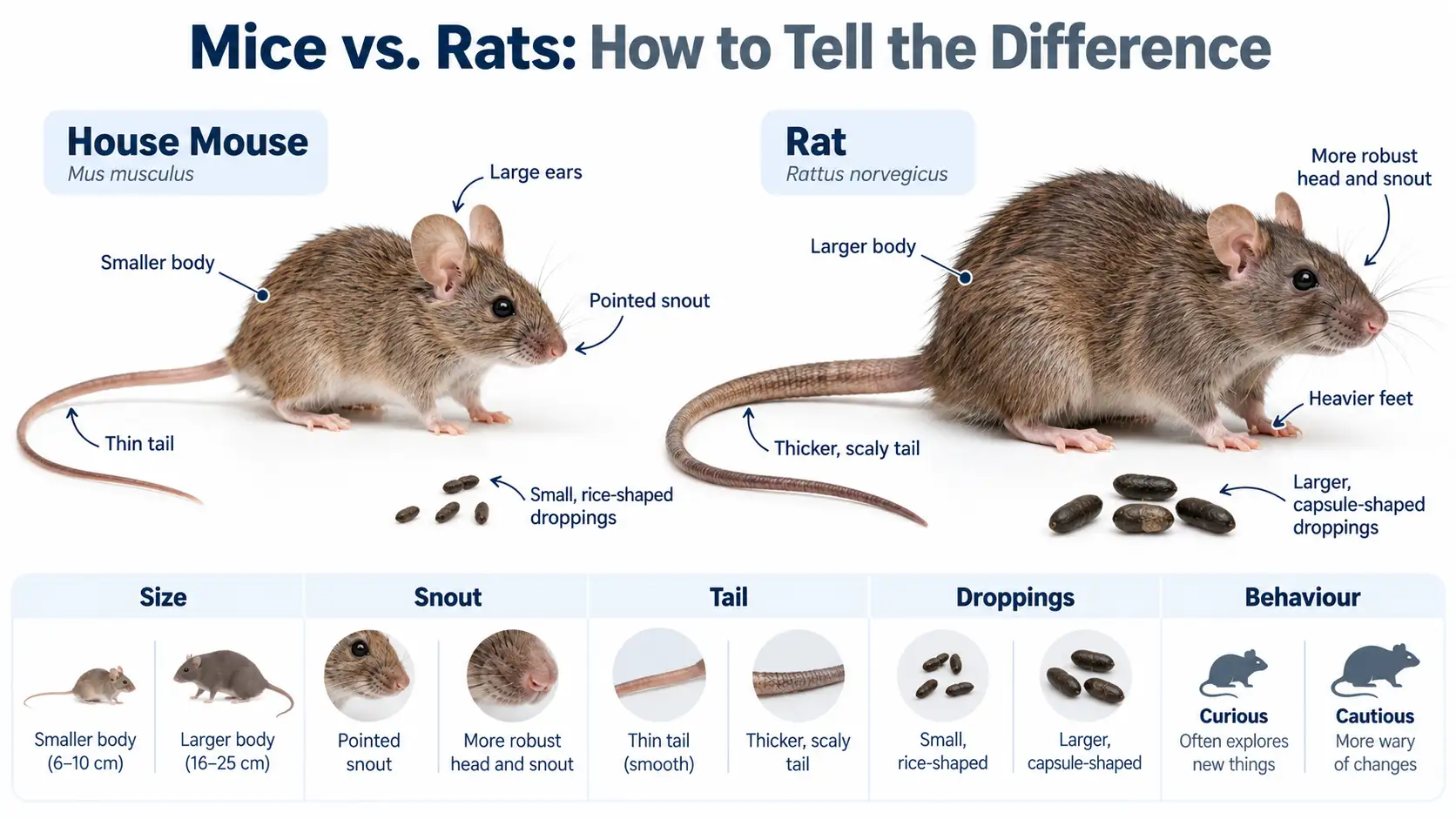
The main differences between mice and rats are their size, body proportions, tails, droppings and behavior. Adult rats are substantially larger than house mice, although young rats can sometimes resemble adult mice.
| Feature | House Mouse | Rat |
|---|---|---|
| Body length (excluding tail) | Approximately 7–10 cm | Approximately 16–28 cm, depending on species |
| Weight | Around 12–30 g | Commonly 150–500 g or more |
| Body shape | Small and slender | Larger and more robust |
| Snout | Narrow and pointed | Blunt in Norway rats; more pointed in roof rats |
| Ears | Large relative to the head | Varies by species |
| Tail | Thin, with fine hair | Thicker, scaly and sparsely haired |
| Droppings | Approximately 3–6 mm | Often 12–20 mm or longer |
| Behavior | Curious and exploratory | Often cautious around unfamiliar objects |
| Food preferences | Grains, seeds and other available foods | Grains, fruit, meat, scraps and other available foods |
These measurements describe common adult rodents and vary with species, age and sex. A single characteristic is not always enough for identification.
House mice and rats differ most noticeably in body size, head proportions, ears and tails. Adult rats are generally heavier, but the proportions of the animal provide better clues when its age is unknown.
A house mouse (Mus musculus) has a small, slender body, pointed snout, relatively large rounded ears and a long, thin tail covered with fine hair. House mice are commonly greyish-brown, although coat color varies. Their small feet and delicate facial features distinguish them from most rats.
An adult house mouse generally measures 7–10 cm in body length, excluding its tail.
Rats are bigger than house mice, with heavier feet and thicker tails. But the two common species of building-associated rat are physically different.
This is important because not all rats have short tails or blunt noses. Roof rats are sometimes more mouse-like in appearance than Norway rats, particularly when young.
Mouse droppings are smaller and thinner than rat droppings. House mouse droppings resemble dark grains of rice, while rat droppings are larger, thicker and more capsule-shaped.
| Dropping feature | House Mouse | Norway Rat | Roof Rat |
|---|---|---|---|
| Typical length | 3–6 mm | About 18–25 mm | About 12–13 mm |
| Shape | Thin, rice-shaped | Thick, capsule-shaped | Elongated, spindle-shaped |
| Ends | Often pointed | Usually blunt | Often pointed |
| Appearance | Small, dark pellets | Larger, dark pellets | Medium-sized, dark pellets |
Mouse droppings are spread around food sources and travel paths. Rat droppings can be found in piles along commonly used paths. However, both rodents can leave droppings in many places. Droppings size also differs with the age and diet of the rodent. A small rat dropping can look like a larger mouse dropping so it’s important to compare other evidence before identifying the species.
Safety note: Avoid handling rodent droppings directly or sweeping or vacuuming them while dry. Follow appropriate public health guidance for safe cleanup.
Rat gnaw marks are generally wider and more pronounced than mouse gnaw marks because rats have larger incisors.
Mice often leave fine tooth marks on food packaging, cardboard, wood and other materials. Rat damage may show wider grooves, heavier chewing or larger openings. Both mice and rats gnaw regularly because their front teeth continue growing throughout their lives.
The size of a chewed opening alone does not confirm the species. The material, age of the rodent and amount of repeated gnawing can affect the appearance of the damage.
Mice are generally more willing to investigate unfamiliar objects, while rats tend to approach changes in their surroundings cautiously. This cautious behavior in rats is called neophobia, meaning avoidance or fear of unfamiliar objects and situations.
| Behavior | Mice | Rats |
|---|---|---|
| Exploring unfamiliar areas | Often curious and exploratory | Often more cautious |
| Approaching new objects | May investigate relatively quickly | May avoid them initially |
| Activity periods | Primarily nocturnal | Primarily nocturnal |
| Movement | Often follows edges and sheltered routes | Also uses established travel routes |
| Climbing | Capable climbers | Roof rats are particularly agile climbers |
These are general behavioral patterns rather than fixed rules. Individual animals can react differently depending on their environment, food availability and previous experiences.
Both mice and rats are omnivores, which means that they will eat both plant and animal material. However, their tastes in food may differ.
House mice usually eat grains, seeds and cereals, but will also eat insects and anything else they can find. Rats eat a wide variety of foods including grains, fruit, meat, pet food and household scraps.
Neither species is a monophagous eater. A chewed up cereal box doesn’t mean you have mice any more than damaged meat or other food means you have rats. Food damage is more useful for identification when combined with other physical evidence such as droppings, gnaw marks etc.
Mice generally build smaller nests from shredded paper, fabric and other soft materials in sheltered spaces. Rats may use similar materials but often establish larger nesting areas or burrows, depending on the species.
| Rodent | Common nesting locations |
|---|---|
| House mouse | Behind appliances, inside cupboards, insulation and wall cavities |
| Norway rat | Ground burrows, beneath structures, basements and crawl spaces |
| Roof rat | Attics, rafters, roof voids and elevated sheltered areas |
Nesting location provides another identification clue. Burrows near the ground may indicate Norway rats, while activity in roof spaces can suggest roof rats. However, mice can also occupy attics, and rats can use wall cavities. The nesting location alone does not confirm the species.
Yes. A young rat can be similar in size to an adult mouse, making identification difficult when relying on body length alone. The most useful differences are their proportions:
Large ears alone are not a reliable distinction because ear proportions vary between Norway rats, roof rats and house mice. When the animal’s size creates uncertainty, comparing its feet, head, tail and overall proportions provides a more reliable identification than judging its length alone.
Yes. Mice and rats can occupy different areas of the same building, although they may compete for food and shelter. Larger rats can also prey on mice. Finding evidence of both species is possible, but differences in droppings alone do not confirm a mixed infestation.
No. House mice and rats belong to different species and genera. A mouse remains a mouse throughout its life. Although a young rat may resemble an adult mouse, it grows into an adult rat, not a different type of rodent.
Yes. House mice have thin tails covered with fine hair, while rats have thicker, scaly tails with sparse hair. Tail length also varies between rat species: roof rat tails are generally longer relative to their bodies than Norway rat tails.
Adult rats are generally much larger than adult house mice. However, young rats can overlap in size with adult mice. Comparing their head, feet and tail proportions helps distinguish similarly sized animals.
Droppings can provide strong identification clues, particularly when their size and shape are distinctive. However, juvenile rodents and variations between species can make identification uncertain. Physical sightings, tracks and gnaw marks help confirm which rodent is present.
Not sure whether you’re dealing with mice or rats? Total Pest Control Ltd provides professional mouse control and rat control services for residential and commercial properties across the Lower Mainland, including Surrey, Langley, Richmond, Delta, Burnaby, Vancouver, Port Moody, Abbotsford and surrounding areas.
Our technicians can inspect rodent activity, identify the species and potential entry points, and recommend appropriate control measures. Call 604-349-6402 or contact Total Pest Control Ltd to arrange a rodent inspection.