Total Pest Control Ltd
For a Free Consultation, Call 604-349-6402

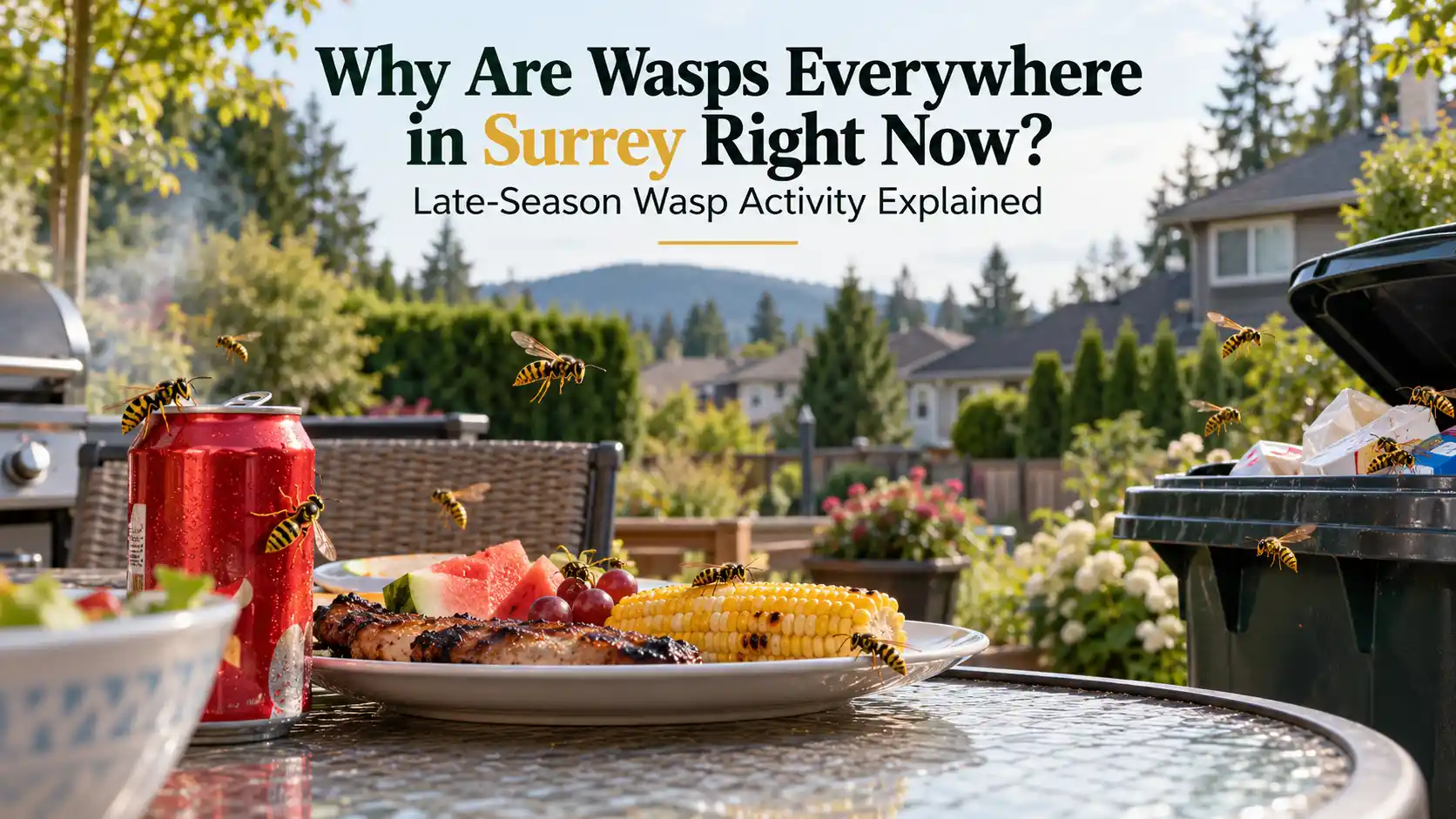
If wasps suddenly seem to be everywhere around your Surrey patio, barbecue, garbage bins or outdoor drinks, there is a seasonal reason.
By late summer and September, yellowjacket colonies can be at or near their largest size of the year. At the same time, natural food availability starts changing, sending large numbers of workers out in search of easy sources of sugar and food. That is why yellowjackets can become much more noticeable around pop cans, ripe fruit, outdoor meals, recycling and garbage at this time of year.
They are not simply becoming aggressive for no reason. There are more wasps foraging, more competition around food and more workers available to defend mature nests if they are disturbed.
Late-season activity can affect homes throughout Surrey, including Whalley, Guildford, Fleetwood, Newton, Cloverdale and South Surrey. The important questions for homeowners are: Why has activity suddenly increased? What is attracting them? How can you keep them away? And how do you know when you are dealing with an established nest that may need professional removal?
Yellowjackets do not suddenly appear in September.
Their colonies have been developing since spring. A queen starts a new nest, produces the first workers and, as the season progresses, those workers help expand the colony and raise more yellowjackets.
By late summer and early fall, a mature yellowjacket colony may contain hundreds or even thousands of workers.
That increase in population is one of the main reasons homeowners suddenly notice far more activity.
A nest may have been nearby for months without creating an obvious problem. By September, however, many more workers are leaving it each day to search for food.
“Starving wasps” describes part of what is happening, but it is not quite as simple as wasps becoming hungry and aggressive.
Adult yellowjackets depend heavily on carbohydrate-rich foods. Earlier in the season, nectar and other natural food sources are more readily available, and the developing larvae inside the colony also contribute to the workers’ food cycle.
As the season changes, natural food becomes less abundant and the colony itself begins changing. At the same time, there may still be a large population of adult workers looking for energy.
The result is more hungry workers competing for changing and increasingly limited natural food sources.
That is when human food becomes especially attractive.
A Surrey backyard can offer several concentrated food sources in a very small area. Yellowjackets are especially attracted to sugary foods and liquids such as:
Open drink cans can be particularly problematic because a yellowjacket may crawl inside without being noticed.
Fruit trees are another common late-season attraction. Apples, pears, plums and other fruit that become overripe or fall to the ground provide an easy source of sugar.
BBQs and outdoor meals can attract yellowjackets as well. Along with sweet foods, workers may collect protein-rich food for developing larvae within the colony.
This means the wasps around your patio are not necessarily nesting beside it. They may simply have discovered a reliable source of food and keep returning while that food remains available.
A yellowjacket hovering around your drink is usually interested in the food rather than deliberately trying to sting someone.
However, late summer creates more opportunities for people and wasps to come into conflict.
There are more workers in the environment. More of them are searching around for the food and drinks people are consuming outside. And mature nests contain more workers capable of defending the colony when it is disturbed.
Problems commonly occur when someone:
The important distinction is that wasps searching for food are mainly a nuisance, while wasps defending a nearby nest can present a much greater sting risk.
If yellowjackets are mainly appearing around outdoor food rather than repeatedly entering and leaving a nest, removing attractants can help reduce the activity.
Bring food outside when you are ready to eat and cover leftovers promptly. Take extra care with sweet drinks. Using bottles with lids or pouring drinks into glasses where you can see the contents can make it easier to notice a wasp.
Juice, pop and other sweet liquids can continue attracting workers after the meal is finished. Clean spills from tables, patios and decking instead of allowing them to dry.
Health Canada recommends keeping garbage tightly covered and avoiding exposed food and drinks outdoors. Keep garbage cans properly closed and, where practical, rinse sugary residue from pop cans, juice containers and other recycling before storing them outside.
If you have fruit trees, remove damaged and overripe fruit regularly rather than allowing it to accumulate on the ground.
Remove food scraps, sauces and residue after cooking and eating.
Food left outside can provide another easy food source for scavenging insects.
If a yellowjacket approaches your food or drink, stay calm and move away rather than trying to hit it.
Reducing food sources can make your patio less rewarding to foraging wasps, but these steps will not eliminate an established nest.
Seeing several wasps around food does not automatically mean there is a nest in your yard. Instead, watch where they are travelling.
One of the clearest signs of a nearby nest is repeated traffic into and out of exactly the same location.
You may notice yellowjackets consistently disappearing into:
A concealed nest can be considerably larger than the visible entrance suggests.
A small hole in the soil or wall may be the only part of the nest you can see, while a mature colony occupies a much larger protected space behind it.
Wasps moving randomly between flowers, food and garbage: likely general foraging activity.
Wasps repeatedly entering and leaving one exact hole or opening: possible active nest.
That distinction can help you decide whether removing attractants is likely to help or whether the source of the problem needs to be addressed.
Late-season timing matters.
A small nest discovered early in the year is very different from a mature yellowjacket colony in September. By this point in the season, some nests may contain large numbers of workers.
Disturbing the nest can trigger a strong defensive response, particularly when the colony is concealed and you cannot see its actual size.
Extra caution is needed when a nest is:
Large, hidden or difficult-to-access nests are generally better assessed by a professional. The Province of British Columbia recommends professional pest-control assistance for difficult wasp problems and nest situations.
If yellowjackets are repeatedly entering a small gap in siding or a soffit, it may seem logical to close the hole.
That can make the problem worse.
When an active nest is inside a wall or another structural void, blocking the visible entrance can cause the wasps to search for another way out. In some cases, that new route can lead further into the building.
The entrance should be properly repaired after the colony has been dealt with and the nest is no longer active, rather than while workers are still travelling through it.
Yellowjacket colonies are seasonal.
As colder weather arrives, most of the colony eventually dies off, while newly mated queens survive elsewhere and establish new nests the following year.
Because of that, not every late-season nest automatically needs to be removed.
If a nest is well away from people and can safely be avoided, waiting for the natural end of the colony may sometimes be reasonable.
The situation is different when an active nest is:
Cold weather may eventually end the colony, but that does not remove the current problem if people are repeatedly passing close to an active nest.
A few yellowjackets investigating your outdoor meal can often be managed by reducing what attracts them. A steady stream of wasps disappearing into the same wall, soffit or ground opening is a different situation.
Professional wasp control is worth considering when:
By late summer and September, the small entrance you can see may lead to a much larger mature colony.
Late-season wasp activity is not limited to Surrey either. Similar problems can occur across the Lower Mainland, including Langley, Richmond, Delta and Burnaby, particularly around homes with outdoor dining areas, fruit trees, garbage storage or established nests.
Total Pest Control provides professional wasp control in Surrey and surrounding service areas, including same-day pest control service when an active nest is creating an immediate problem.
If you are seeing occasional yellowjackets around food, start by removing the attractants. But if you notice constant traffic into the same opening, a ground nest, activity inside a wall or soffit, or heavy wasp activity around an area your family regularly uses, the source of the problem may need to be dealt with.
Contact Total Pest Control for professional same-day wasp control or nest removal in Surrey and help dealing with an active late-season nest safely.
