November is when Langley puts things away for winter. RVs go into storage lots, boats come off the water, and trailers, ATVs and lawn tractors get parked in sheds and barns until spring.
It’s also when mice are looking hardest for shelter. A stored vehicle or a quiet shed gives them everything they want: it’s dry, dark, undisturbed for months and full of soft nesting material.
The result often shows up in March or April. Owners open the RV to find chewed wiring, shredded cushions and droppings in every cupboard. A few steps now can save an expensive repair later. Here’s how to keep mice out of your RVs, boats and sheds this winter.
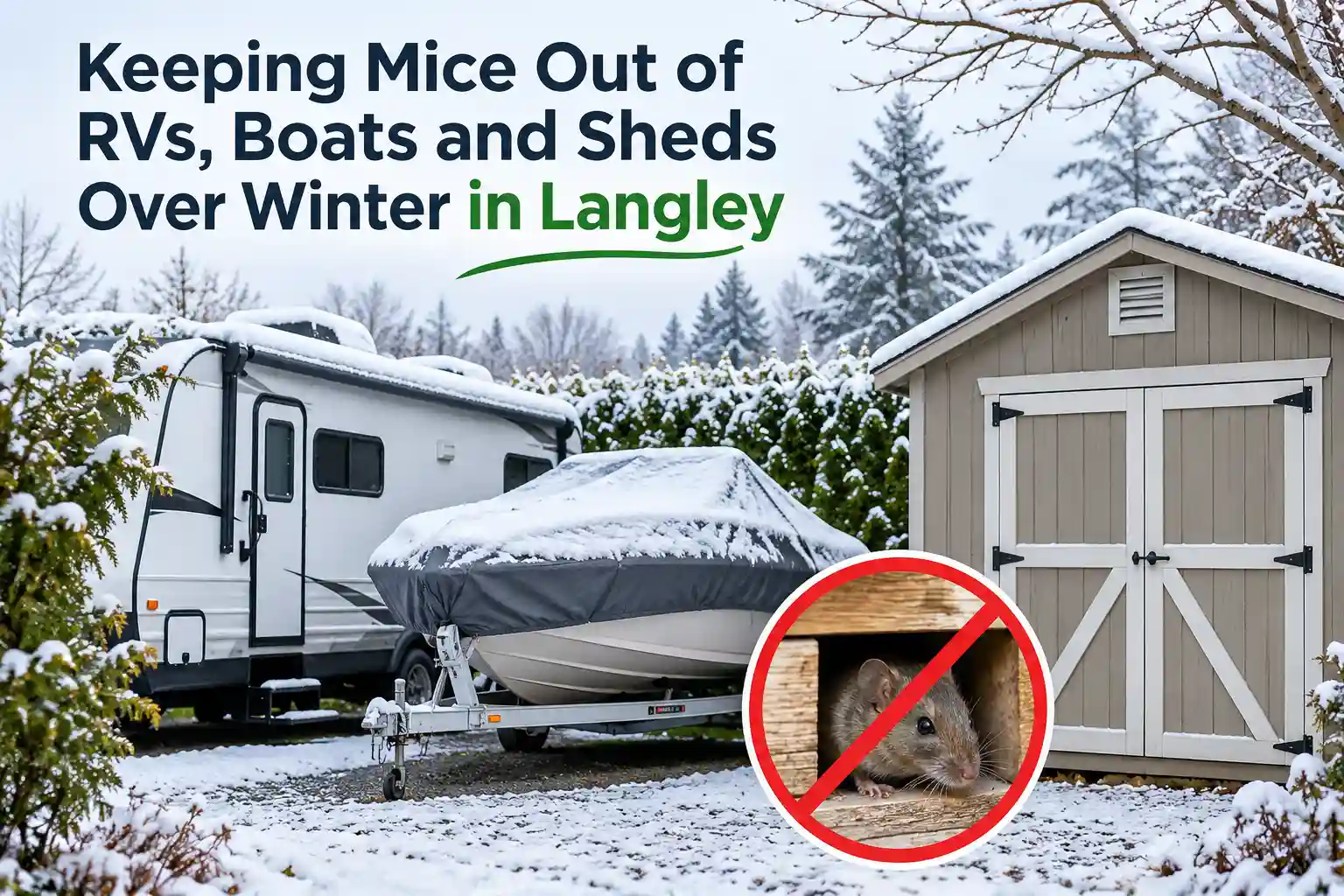
Why mice move into stored vehicles and sheds in Langley
Much of Langley is semi-rural. Acreages, hobby farms and properties backing onto fields and forest are common in areas like Aldergrove, Brookswood, Glen Valley and Otter. That puts homes and outbuildings right next to the open land where mice live all summer.
Once the fields are harvested and the weather turns cold and wet, mice move toward the nearest shelter. On a rural lot, that is usually a barn, shed, garage or anything parked beside them. Stored vehicles are especially attractive because they offer:
- Shelter from rain and wind, with insulation in the walls and floors
- Nesting material, such as seat foam, mattress stuffing, insulation and paper
- Food, from crumbs, pet food, birdseed or snacks left in cupboards
- No disturbance, often for four or five months
Mice can squeeze through a gap about the width of a pencil. RVs, campers and boats have plenty of openings that size, around plumbing, wiring and propane lines, vents, slide-out seals and gaps in the underbelly.
The damage mice can do over one winter
A single mouse can do a surprising amount of damage, and by spring there is rarely just one.
- Chewed wiring. Mice gnaw constantly to keep their teeth in check. Wiring harnesses in engines, generators and RV electrical systems are a common target, and the repairs can be costly. Damaged wires can also be a fire risk.
- Ruined upholstery and bedding. Seat cushions, mattresses and curtains are shredded for nests.
- Insulation and duct damage. Nests in walls, floors and air ducts are hard to reach and can block vents.
- Contamination. Droppings and urine soak into fabrics and cupboards, leaving a strong smell that’s hard to remove.
- Health risks. Rodent droppings and urine can carry disease. Deer mice, which are common in rural BC, can carry hantavirus. That’s why clean-up needs care (see below), and why our guide to the diseases mice can spread is worth a read.
Pre-storage checklist: RVs, campers and boats
Work through this list before you park for the winter.
- Remove all food. Empty the fridge, pantry and cupboards completely, including sealed packets, pet food, spices and anything in the cabin of a boat.
- Deep clean. Vacuum crumbs from floors, under seats and inside drawers. Wipe down counters and the stovetop.
- Take out soft materials you don’t need. Bring bedding, towels, cushions and paper products indoors, or store them in sealed plastic bins.
- Seal the gaps. Check underneath for openings where plumbing, wiring and propane lines enter. Pack small gaps with copper or stainless steel mesh, then seal over it. Mice chew through foam and caulk alone.
- Cover vents and exhaust openings with fine metal mesh, making sure you remove anything that would block a vent before using appliances again.
- Check the seals on doors, windows, slide-outs and storage bays, and replace any that are cracked or missing.
- Open the hood occasionally. For motorhomes and tow vehicles, a quick check of the engine bay every few weeks lets you catch nesting early.
- Choose your parking spot carefully. Where you can, avoid parking right beside long grass, woodpiles, hedges or hay storage, which give mice cover to approach.
Pre-storage checklist: sheds, barns and garages
- Store seed, feed, birdseed and pet food in metal or thick plastic containers with tight lids.
- Keep firewood, scrap wood and clutter off the floor and away from walls.
- Check the base of doors and walls for gaps, and fit door sweeps where needed.
- Raise stored items onto shelves so you can see underneath them.
- Keep grass and vegetation cut short around the building.
For more on getting your property ready, see our guide to preparing for fall rodent activity.
Home remedies that don’t hold up over winter
RV forums are full of tips for keeping mice away. Most don’t work well over a long storage season.
- Dryer sheets and peppermint oil. The scent fades within days or weeks, and a mouse looking for winter shelter won’t be put off for long.
- Mothballs. They aren’t made or labelled for rodents, and the fumes build up in closed spaces like campers and boat cabins.
- Ultrasonic repellers. Results are inconsistent, and the sound doesn’t pass through walls or furniture.
- A few snap traps. Traps are useful for checking whether mice are present, but on their own they rarely keep up with mice moving in from surrounding fields.
What works is a combination: removing what attracts mice, blocking the ways in, and monitoring so you catch activity early.
Signs mice have moved in, and how to clean up safely
Check your RV, boat or shed every few weeks over the winter, and again before you take it out in spring. Look for:
- Small, dark droppings about the size of a grain of rice, often in drawers, cupboards and corners
- Chewed fabric, paper, foam or food packaging
- Nests of shredded material behind panels, under seats or in the engine bay
- A musty, ammonia-like smell
- Gnaw marks on wiring, hoses or wood
- Electrical faults or warning lights when you start the engine
Not sure whether it’s mice or rats? Our guide on how to tell mice and rats apart can help.
Don’t sweep or vacuum droppings dry. That can stir contaminated dust into the air. Instead:
- Open doors and windows and let the space air out for at least 30 minutes.
- Wear rubber or disposable gloves, and a mask if the area is heavily soiled.
- Spray droppings and nesting material with a disinfectant or a bleach solution and let it soak for several minutes.
- Wipe up with paper towels and seal everything in a plastic bag for the garbage.
- Disinfect the surfaces again, disinfect your gloves before taking them off, then wash your hands with soap and water.
For large infestations, or enclosed spaces with heavy contamination, it’s safer to call a professional. BC public health authorities also publish guidance on cleaning up after rodents.
When to call a professional
If you’re finding signs of mice every winter, or you have several outbuildings, vehicles and animals to protect, a professional plan is usually more reliable than DIY. On Langley acreages and farm properties, Total Pest Control can:
- Inspect your RV, boat, sheds, barns and garage for entry points and signs of activity
- Seal entry points with rodent-proof materials (exclusion)
- Install tamper-resistant bait stations around outbuildings, placed and checked so they’re safer around children, pets and livestock
- Follow up through the winter so activity is caught before it becomes damage
We serve homes and properties across Langley, including Aldergrove, Brookswood, Walnut Grove, Willoughby, Murrayville and Fort Langley. Storing something valuable this winter? Book a rodent inspection in Langley or request a free quote before the cold sets in.
Frequently asked questions
How do mice get into an RV?
Mostly from underneath, through gaps where plumbing, wiring and propane lines pass through the floor. Worn door and slide-out seals, vents and storage bays are other common entry points.
Can mice damage a stored boat?
Yes. Mice nest in cabins, under seat cushions and in engine compartments, and can chew wiring, upholstery and canvas covers.
Do dryer sheets keep mice out of an RV?
Not reliably. The scent fades quickly, and mice looking for winter shelter are rarely put off for long. Sealing entry points and removing food works far better.
How often should I check my stored RV or boat for mice?
Every few weeks through the winter, and again before you use it in spring. Catching early signs saves on repairs.
Is it safe to clean up mouse droppings myself?
Small amounts can be cleaned carefully. Wet them with disinfectant first, wear gloves, and never sweep or vacuum them dry. For heavy contamination in enclosed spaces, call a professional.
Do you offer rodent control for farms and acreages in Langley?
Yes. We work with rural properties across Langley, including barns, sheds and outbuildings, using exclusion and tamper-resistant bait stations.